Tech Empire
A single-player business simulation about running a technology company. You act as its CEO, CTO, and CFO at the same time: building products, managing staff and finances, going public, and competing with rival firms.



このゲームについて
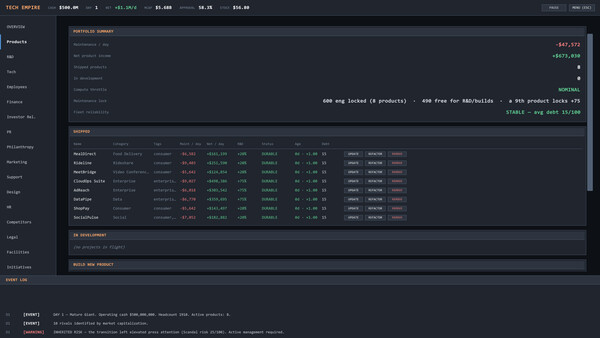
You run a technology company as its CEO, CTO, and CFO at the same time. The interface is a dashboard of tables, charts, and a scrolling event log.
Each campaign begins from one of five hand-built scenarios — a bootstrapped garage with no outside funding, a seed-stage accelerator startup, an established mid-size firm, an inherited company in decline, or a public giant — or from a randomized company drawn somewhere in between.
Roles
As CEO you set company strategy and handle the board, shareholders, and press. As CTO you run R&D, choose product architectures, and manage technical debt. As CFO you set pricing, raise capital, run payroll and taxes, and manage cash flow. The three roles overlap and trade off against each other.
Products and research
You build products in several categories — consumer apps, enterprise software, cloud, AI, hardware, and games — from more than 50 templates. Each build is configured before release: monetization, privacy setting, launch scope, quality target, and tech stack. Those choices set its cost, revenue, maintenance, and risk. Research follows a tech tree of about 50 nodes across five branches, gated by cash, headcount, prerequisites, and time. The company also begins with an undisclosed advantage in matrix multiplication that lowers the cost of AI research until it leaks.
Systems
Ten company functions — engineering, design, support, marketing, PR, legal, HR, and finance among them — share a set of values: quality, technical debt, customer satisfaction, morale, public image, cash, and investor confidence. The functions feed back on one another. An understaffed support desk lowers morale, which raises attrition, lowers product quality, reduces revenue, and shortens the runway. Difficulty is mostly emergent.
The IPO
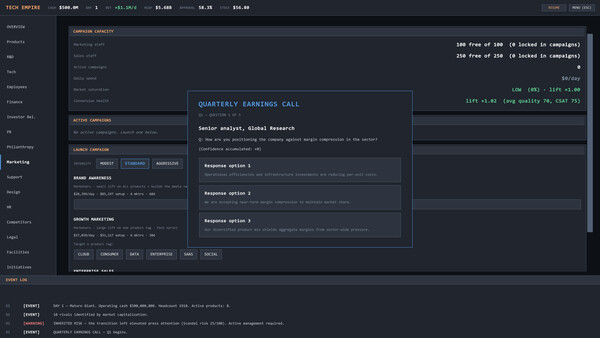
The IPO is a multi-stage event: select underwriters, file the S-1 and set a disclosure level, choose a price range, run the roadshow, and receive a listing-day result. Afterward you manage a live market cap, attend quarterly earnings calls, and report to a seven-seat board that can vote to remove you.
Competitors
Competing firms build their own product lines and contest yours. A product released into a category a competitor already leads earns reduced revenue until you outbuild it. You can outcompete a rival or acquire it. Removing all competitors grants a monopoly pricing premium, raises antitrust risk, and tends to push the remaining firms to merge.
Failure conditions
Most threats are internal. The game includes more than 100 written crisis events — staff walkouts, regulatory findings, security breaches, financial shocks, board disputes, and occasional positive events — each with branching choices and lasting effects. There are three failure conditions: bankruptcy (cash reaches zero), board recall (approval falls below the threshold and the recall vote fails), and investor ouster (confidence reaches zero before the IPO). There is no win condition. The long-term targets — a one-trillion-dollar valuation, a market monopoly, or surviving a set number of days — are milestones, not endings.
Summary
1. Five hand-built starting scenarios plus a randomizer, from a bootstrapped garage to a public giant.
2. 50+ product templates with per-build configuration; a tech tree of roughly 50 nodes.
3. Five-stage IPO, quarterly earnings calls, seven-seat board of directors.
4. 100+ crisis events, a macro-economy and per-sector market sentiment that shift over time.
5. Keyboard-driven dashboard interface, dark theme.